Welding, Filler & Plating: What Passes the NCT
Most people understand that serious rust means an NCT failure. What catches drivers out is the repair side - specifically, which repair methods are actually acceptable under the NCT standard and which ones will see you fail again at retest.
There is a lot of bad information circulating about this. Some of it comes from well-meaning mechanics who do not specialise in structural metalwork. Some of it is wishful thinking from people trying to pass a car on a tight budget. The result is vehicles that arrive at the test centre with repairs that look fine at a glance but do not meet the standard.
This post covers exactly what the NCT standard requires for structural corrosion repairs, which methods pass, and which ones do not.
What the NCT Is Actually Checking
The NCT inspection includes an underbody assessment on a lift. The inspector is looking at the chassis rails, floor pan, sill box sections, suspension mounts, brake and fuel lines, exhaust, and steering components - all of it visible from underneath.
For corrosion specifically, the standard works in zones. The most critical zone is what is called the “prescribed area” - this is the area within 30cm of any mounting point for a testable component. Suspension, brakes, steering, seatbelts: all of these have mounting points in the underbody, and corrosion within 300mm of those mounts is assessed very closely.
In the prescribed area, corrosion fails if there is any hole in the metal, if the metal does not feel firm under thumb pressure, or if an assessment tool makes a hole. That last point matters: the inspector is not just looking at the surface. If the underlying metal has lost significant thickness, it will fail even if the outer face looks intact.
Highly-stressed structural members - chassis rails, sill box sections - are also assessed for serious thickness loss, holes, and splits even outside the prescribed area. These are load-bearing sections and the standard reflects that.
Defect Grades and What They Mean
NCT defects are graded Minor, Major (Fail), or Dangerous (Fail).
Structural chassis corrosion that compromises the integrity of the vehicle is classified as a Dangerous fail. This is the most serious outcome. A Dangerous fail means the vehicle must not be driven from the test centre - not home, not to a workshop, not anywhere. It has to be transported.
This catches people off guard. They bring a car in expecting a standard fail with a retest in two weeks, and they are told they cannot drive it out. Understanding this before you go to the NCT - and making sure your repairs are correct before you go - matters significantly.
What Is Not an Acceptable Repair
Let’s be direct about the repair methods that do not pass.
Body filler on structural sections is not acceptable. Full stop. The NCT standard is explicit: repairs to primary structure must be carried out by welding in new metal. Filler is a surface cosmetic material. It has no structural strength. It will crack, absorb moisture, and allow the underlying rust to continue. An inspector will find it - and if it is covering a structural defect, the result is the same Dangerous fail the original corrosion would have caused.
Fibreglass over rot is in the same category. A fibreglass patch feels solid to a quick tap, but it provides no load-bearing contribution to the structure beneath it. It is a cover-up, not a repair.
Plating over existing rust - welding a steel plate on top of corroded metal without cutting the rot out first - is also not acceptable. This one fools more people because it involves actual welding. But the corroded metal underneath the plate remains. It continues to rot, the plate lifts at the edges, and the structural section is still compromised. A good inspector will look at the quality and nature of the weld repair and assess whether the underlying section was properly addressed.
These are not minor technical points. They are the difference between a repair that holds and one that is actively dangerous.
What the NCT Standard Requires
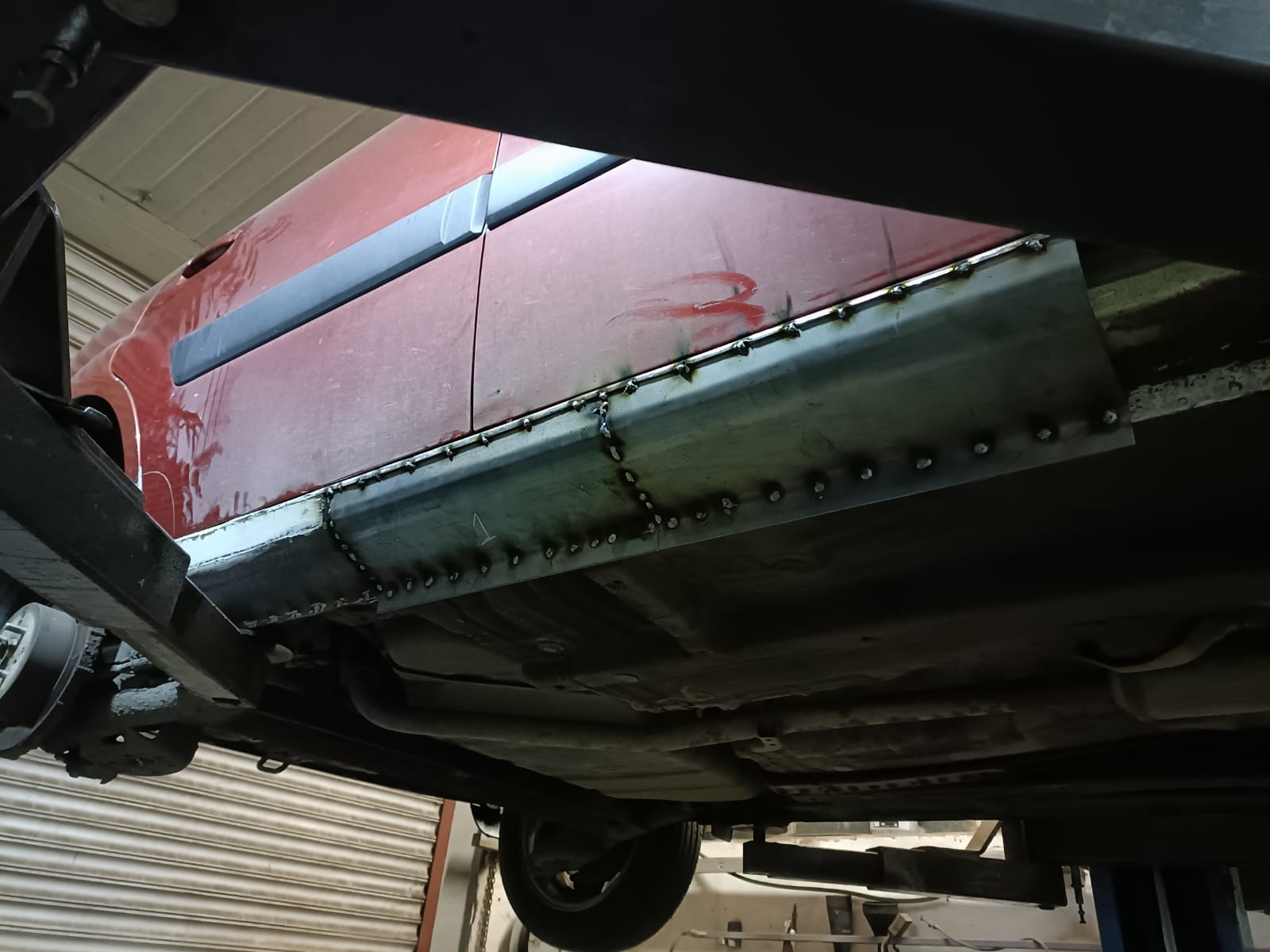
The repair method required for structural corrosion is straightforward: cut out the corroded section fully, back to sound metal, and weld in new steel of the same gauge.
This is the only method that restores structural integrity. The new metal carries load. The weld joins it to the sound surrounding structure. The repair is solid, not a cover.
For the prescribed area - that 30cm zone around suspension, brake, steering, and seatbelt mounts - repairs need to be clean and complete. A poor weld in this area, one with gaps or inadequate penetration, will not pass any better than filler will.
The same applies to chassis rails and sill box sections. These are the primary structural members of most modern cars. Sills carry significant load in the body structure. A proper sill repair involves cutting out the corroded box section - inner sill, outer sill, or both - and welding in new fabricated sections. You cannot patch the outer face and leave the inner to rot.

Cut-and-Weld vs Plate-and-Hope
It is worth spelling out the practical difference between a proper repair and a bodge, because from the outside they can look similar until you know what to look for.
A proper cut-and-weld repair:
- Removes all corroded metal back to sound, solid steel
- Fabricates new sections from steel of the correct gauge
- Welds them in with proper penetration and fusion
- Leaves the structure as strong as it was originally - or close to it
A plate-over-rust repair:
- Welds or bonds a patch on top of the affected area
- Leaves the corroded metal underneath
- Creates a moisture trap between the plate and the original steel
- Accelerates corrosion in the covered area
- Provides no genuine structural restoration
The second type is faster and cheaper to execute. It is also not a repair. It is a delay, and an expensive one if the vehicle subsequently fails inspection or, worse, if the structural weakness contributes to an accident.
The 30cm Prescribed Area in Practice
The 30cm rule has practical consequences that are worth understanding.
On most cars, the suspension mounts are in the floor pan or chassis rails. The seatbelt lower anchorages are in the sill or floor. Brake and fuel lines run along the chassis rails. Steering rack mounting points are in the subframe.
This means that a significant proportion of the vehicle’s underbody is within the prescribed area of one component or another. Corrosion that might seem minor in isolation - a patch of thinning metal in the floor, for example - can be a fail because of where it is rather than how severe it looks.
This is why a proper underbody inspection, done by someone who understands where the prescribed areas actually fall on a given vehicle, is useful before you go to the NCT. You want to know what you are dealing with before the inspector tells you.
Why Quinn Engineering’s Approach Is What It Is
At Quinn Engineering in Omeath, we do not use filler on structural sections. We do not plate over rust. The reason is not a policy preference - it is that any other approach does not meet the standard and is not structurally sound.
Every underbody welding repair we do involves cutting the corroded section out completely and welding in new steel. That is the only method we use for primary structure, because it is the only method that actually works.
If you have had work done elsewhere and you are not confident it was done correctly - or if you have been quoted for a repair that sounds like it might involve filler or plate-and-leave - it is worth getting a second look before you arrive at the test centre.
Before You Book the NCT
If your vehicle has a known corrosion issue, or if it has failed the NCT for structural reasons before, the order of events matters.
Get the repairs done first, by someone who does this work properly. Then book the NCT.
Arriving with a Dangerous fail item that has been covered with filler is not a shortcut to passing. It is a shortcut to a more expensive problem - a second fail, a vehicle you cannot drive home, and repair costs on top of the original issue.
For a more detailed look at what the NCT flags and how it grades corrosion defects, see our post on NCT rust fails in Ireland. If you want to understand the difference between a structural weld repair and a patch job in more depth, welded vs patched underbody repair covers that in detail.
Get a Proper Assessment Before Your NCT
Quinn Engineering is in Omeath, Co. Louth, on the Cooley Peninsula - around 20 minutes from Dundalk and 10 minutes from Carlingford. We work on cars, vans, 4x4s, campers, and trailers.
If you want to know what your vehicle actually needs - before you go to the NCT, before you commit to repairs - send photos to WhatsApp at 083 807 7144 and we will give you a straight answer. No charge for an assessment quote, no obligation.
We do cut-and-weld structural repairs. We do not do filler on structure.
Frequently Asked Questions
Is body filler an acceptable repair for the NCT?
No. Body filler is not acceptable on primary structure. The NCT standard requires that structural corrosion repairs are carried out by welding in new metal of the same gauge. Filler may hold cosmetically for a short time but provides no structural strength and will be rejected.
Can you plate over rust to pass the NCT?
Plating directly over existing corrosion is not an acceptable repair. The correct method is to cut out the corroded metal fully and weld in a new section. Any repair that leaves rotten metal in place underneath a plate is likely to fail on inspection and will continue to corrode regardless.
Why does a proper weld pass when filler doesn't?
A proper cut-and-weld repair restores the structural continuity of the metal. The new steel carries load the same way the original section did. Filler, fibreglass, and plate-over-rust repairs do not restore strength - they only cover the problem, and an experienced inspector will identify them.
What is a Dangerous fail on the NCT for corrosion?
A Dangerous fail (also called an X3 defect) is the most serious NCT outcome. Structural chassis corrosion that compromises the integrity of the vehicle can result in a Dangerous fail, which means the vehicle must NOT be driven away from the test centre. It cannot be driven home to be repaired.