Land Rover & 4x4 Chassis Repair in Ireland
The Land Rover Defender has a well-earned reputation for being fixable. Parts are available, the engineering is straightforward, and they were built to be maintained. But that reputation cuts both ways: Defenders also have a well-earned reputation for chassis rot, and the Irish climate is one of the worst environments a box-section steel chassis can live in. Left unchecked, it is not a fixable problem - it becomes an expensive one.
Here is what actually happens to Defender and 4x4 chassis in Irish conditions, where the rot starts, and when repair makes sense versus when you are looking at a bigger job.
Why Defender Chassis Rot Is a Structural Problem, Not a Surface One
Most people know that Land Rovers rust. What catches owners out is that the rot on a Defender chassis typically starts on the inside of the box sections and works outward. By the time the surface looks bad, the steel underneath has often been compromised for years.
The original factory underseal on older Defenders is the problem. It was applied to the outside of the chassis sections and does a reasonable job when intact. But underseal cracks with age, particularly at weld seams and anywhere the chassis flexes in use. Water gets into those cracks, sits against the steel, and starts the rot. The underseal then holds that moisture in place rather than letting it drain.
The inside of the box sections has no protection beyond whatever residual oil or coating was there at manufacture. Moisture that gets in through drain holes, weld seams, or cracked underseal has nowhere to go. In a wet climate like Louth - where annual rainfall runs close to 950mm and the Cooley peninsula sits right on Carlingford Lough with coastal salt air year-round - that trapped moisture does serious damage over a long period.
The result is a chassis that can look structurally sound from outside while being significantly weakened from within. You tap the section and it sounds hollow. You probe it and the tool goes through. That is not a surface rust job - it is a structural repair.
Where It Starts: The Areas to Check First
Defender chassis rot follows a fairly consistent pattern. The rear cross-member goes first in most cases. It sits low, it traps mud and moisture, and it takes the weight of anything towed. Once that is gone, both chassis rails tend to follow - top, sides, and bottom - working forward from the rear.
The outriggers are the next concern. These are the lateral sections that connect the main rails to the body mounting points, and they are exposed, horizontal, and collect debris. Weld seams along the outriggers are a primary entry point for water, and the bolt holes where body mounts attach are another.
Other areas that need checking on any Defender or older 4x4:
- Both main chassis rails, full length, particularly the top flanges where they are harder to see and easier to miss on a quick visual check
- Weld seams along the rail sides - these crack with age and flex, and are where underseal first lifts
- Bolt holes for body mounts, suspension mounts, and cross-member fixings - these are entry points for water and the steel around them takes the stress
- Suspension and steering mounting points - corrosion here is a direct NCT structural fail

The Galvanised Chassis Question
A lot of Defender owners have invested in a galvanised chassis replacement at some point, and assume they are done with the rust problem. The galvanising does a good job on the outer surfaces - it will outlast bare steel by a significant margin. But box sections still trap moisture inside regardless of what the exterior surface is coated with.
Water gets in through the same routes: drain holes, weld seams, bolt holes. Once inside a sealed box section, it has nowhere to go. The interior walls are not galvanised. The rot progresses from the inside, and the galvanised exterior hides it until the section is opened up or probed.
If you have a galvanised chassis and the vehicle has spent time off-road or on a farm - particularly on the Cooley peninsula or across north Louth where conditions are wet and muddy for a long stretch of the year - it is still worth getting the chassis inspected properly rather than assuming the galvanising has taken care of everything.
Farm and Off-Road Use Makes It Worse
A Defender used on a farm or for regular off-road work in Irish conditions takes on damage faster than one that spends its life on tarmac. The reasons are straightforward.
Off-road use strips underseal. Every rock strike, every scrape through undergrowth, every river crossing chips away at the protective coating on the underside of the chassis. Once the underseal is gone from a section, bare steel is exposed directly to mud, water, and road salt when the vehicle goes back onto public roads.
Farm Defenders also tend to accumulate mud and organic material in sections of the chassis that see limited airflow. Mud that stays damp against steel for weeks at a time - particularly during the wetter months from autumn through spring - accelerates corrosion significantly compared to a chassis that gets the chance to dry out.
The Cooley peninsula and north Louth generally have exactly the conditions that make this worse: high annual rainfall, proximity to the sea, and a lot of agricultural land where 4x4s are working vehicles rather than leisure ones. Vehicles based in this area need underbody inspection more regularly than those in drier inland locations.
Our chassis repair service covers both structural section repair and full underbody assessment for 4x4s and farm vehicles across Louth and the border area.
Patch Repair Versus Full Chassis Swap
This is the decision that matters most once you know what you are dealing with. The right answer depends on how much of the chassis is actually compromised.
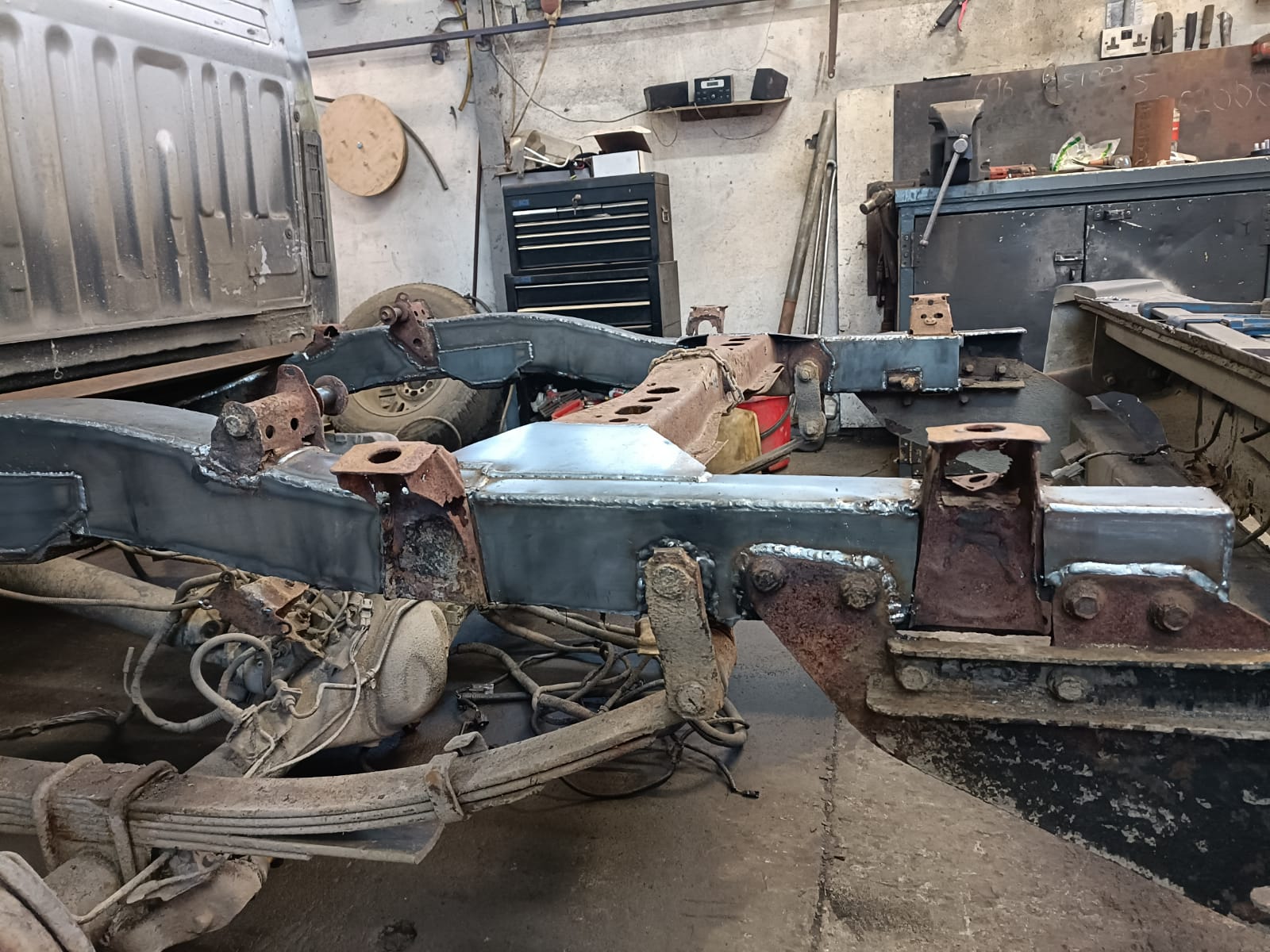
Patch welding makes sense when the rot is localised. If the rear cross-member has gone but the rails are still solid, cutting out the cross-member and welding in new steel is a straightforward job that restores structural integrity to that section without touching the rest. Same logic applies to individual outriggers or a contained section of rail. A repair like this, done properly with welded new metal rather than filler, is structurally sound and significantly cheaper than a full swap.
Full chassis replacement becomes the right call when both rails are extensively compromised across most of their length, all the cross-members are gone, and the overall structure has deteriorated to the point where you would be welding more new steel than original steel remains. At that point you are doing most of the work a full replacement involves anyway, but with the additional complexity of working around a failed structure. A replacement chassis in that situation is often cleaner in practice and comparable in cost.
The only way to know which side of that line you are on is a proper assessment. A visual from underneath is not enough on a Defender - you need to probe the sections and in some cases open them up to see what the interior looks like.
See our guide on chassis repair versus replacement for a more detailed breakdown of how that decision works in practice.
What This Means for the NCT and CVRT
Structural chassis corrosion is not an advisory item at the NCT. If the chassis rails, cross-members, or outriggers show corrosion that has compromised structural integrity - holes, sections that compress under finger pressure, metal that fails a probe test - the vehicle gets a Dangerous fail. That grade means the vehicle cannot legally be driven from the test centre.
Repairs to primary structure must use welded new metal of the correct gauge. Body filler is not acceptable on structural sections and an NCT inspector will identify it. The repair has to be done properly.
Larger Land Rovers and 4x4s over 3,500kg go through the CVRT rather than the NCT. The CVRT includes a full visual underbody inspection and applies the same standard to structural corrosion. The test fee for vans and jeeps is EUR 131.41 in 2026 and the annual frequency from year one means these vehicles are getting looked at regularly.
For a detailed breakdown of how corrosion is assessed at the NCT, the signs of chassis damage post covers what inspectors are looking for and how to identify the same warning signs yourself.
Getting Your Defender or 4x4 Assessed
Quinn Engineering is in Omeath on the Cooley peninsula, about 20 minutes from Dundalk on the R173 coast road. We work on Land Rovers, 4x4s, farm vehicles, and trailers - structural welding is the core of what we do, not a sideline.
If your Defender or 4x4 has been off-road regularly, is getting on in years, or has already flagged corrosion at a test, get it looked at properly before the rot progresses further. Localised repair now is always cheaper than a bigger job later, and significantly cheaper than a Dangerous fail at the NCT.
Call Stephen on 083 807 7144, or send photos of the underbody via WhatsApp at https://wa.me/353838077144 for an initial view before you come in. More detail on our chassis repair work here.
Frequently Asked Questions
Is it worth repairing a Defender chassis or should I just buy a galvanised replacement?
It depends on how much of the chassis is gone. Early or localised rot - rear cross-member, a section of rail, one or two outriggers - is straightforward to repair and costs a fraction of a full chassis swap. If both rails are extensively compromised and the cross-members are all gone, a replacement chassis may actually be the cleaner option. A proper inspection tells you which side of that line you're on.
My Defender has a galvanised chassis - does it still rust?
Yes. The galvanised coating protects the outer surface well but box sections trap moisture inside and rust from the interior wall outward. The coating hides what's happening underneath until you get a probe in there or cut a section open. Weld seams, bolt holes, and drain points are where water gets in and stays.
Will chassis rust fail the NCT or CVRT?
Structural corrosion that compromises chassis integrity is graded Dangerous at the NCT - the vehicle cannot be driven from the test centre. Land Rovers and larger 4x4s over 3,500kg go through the CVRT instead, which includes a visual underbody inspection. Either way, a fail on structural corrosion means the repair has to happen before the vehicle goes back on the road legally.
How much does Land Rover chassis repair cost in Ireland?
Market rates for significant chassis repair in Ireland start around EUR 1,200-2,500+ depending on what sections need replacing. A full multi-area restoration can run EUR 3,000-6,000+. The only way to get an accurate figure for your vehicle is a proper inspection first - call for a quote.