Rust Repair Specialists in Dundalk — Why Irish Cars Rust
Why Do Irish Cars Rust So Quickly?
Anyone who’s driven a car in Ireland for more than a few years, or anyone who’s been through an NCT with a vehicle over 10 years old, has a working understanding that Irish conditions are hard on vehicles. But “it’s the climate” is an oversimplification. There are specific, identifiable reasons why vehicle corrosion is particularly aggressive in Ireland — and in Co. Louth specifically.
Understanding the causes helps you protect against them and helps you recognise when the damage has progressed to the point where professional structural repair is needed.
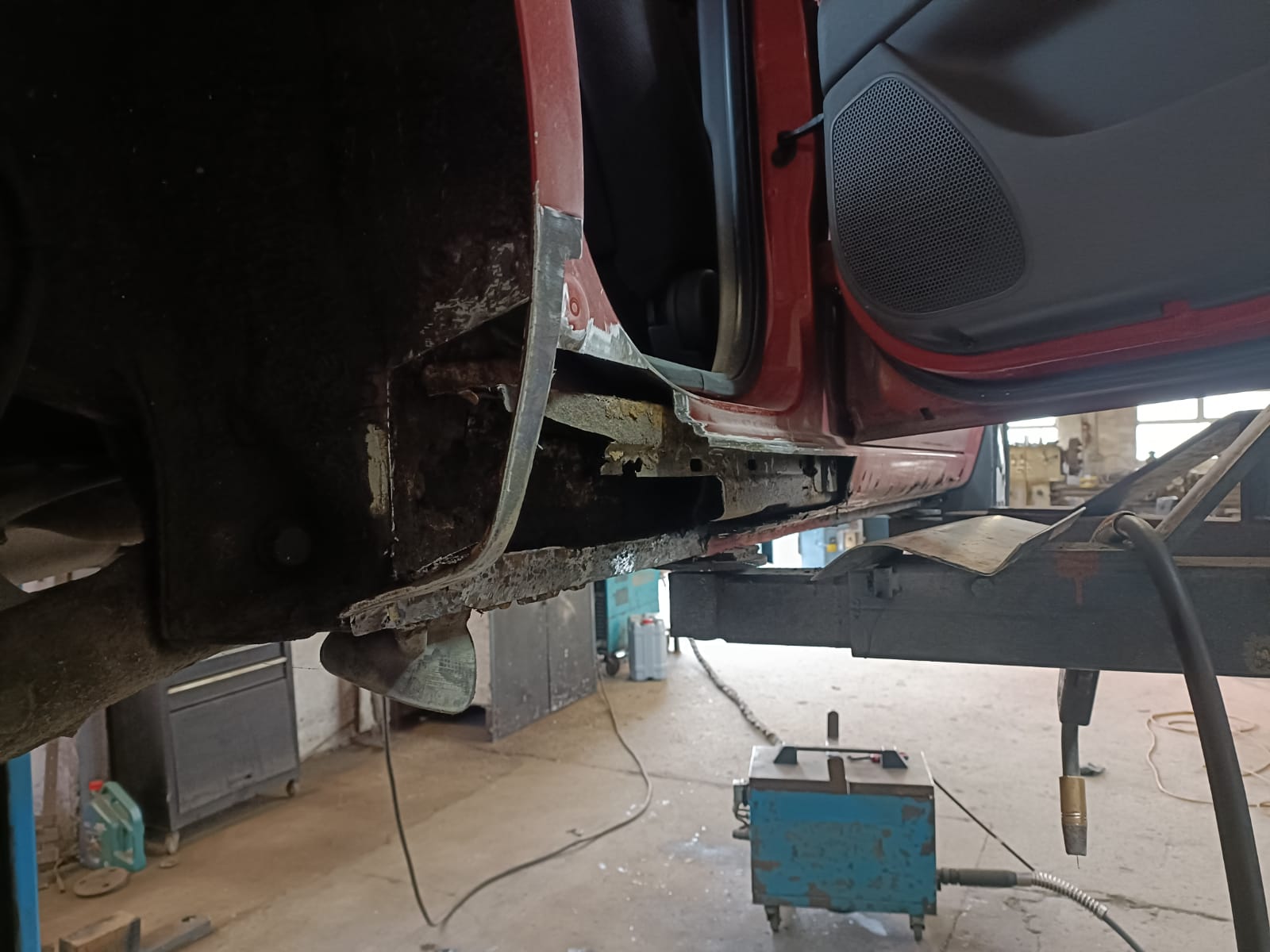
Reason 1: Road Salt
Road salting in Ireland has increased significantly over the past 15 years. Since the severe winters of 2009–2010, local authorities and Transport Infrastructure Ireland have substantially increased the salt spread rates and the trigger temperature for gritting on national and regional roads.
The A1 and A91 corridors through Co. Louth are heavily gritted routes. Both are priority roads in the TII and Louth County Council gritting programmes, meaning they receive treatment earlier in the season, at lower trigger temperatures, and more frequently than secondary roads.
Road salt — sodium chloride — is corrosive to steel by a mechanism that’s chemically distinct from plain water corrosion. Salt ions accelerate the electrochemical oxidation of iron, break down the protective oxide layer that forms naturally on steel surfaces, and remain active in the corrosion process even after the road surface has dried. A vehicle driven on a salted road doesn’t leave the corrosive environment when it parks — the salt residue remains on the underbody until it’s washed off.
In concrete terms: steel corrosion in a salt solution environment progresses at 3–5 times the rate of corrosion in fresh water. Irish vehicles after a decade on salted roads carry that acceleration on every exposed underbody surface.
Reason 2: Persistent Damp Climate
The difference between Ireland and colder continental European countries — Scandinavia, Germany, the northern European plain — is that those climates have cold dry spells as well as cold wet ones. Ireland, in the mild oceanic climate regime, is almost never dry for long enough to give vehicle underside metalwork a genuine drying-out period.
Moisture that penetrates into box sections — sills, chassis rails, door cavities — in a cold, dry continental climate has a chance to evaporate during dry spells. In the Irish climate, it doesn’t. Box sections stay wet for extended periods, and internal corrosion progresses continuously.
The specific impact on Co. Louth: the area sits between the Irish Sea coastal zone (humid) and the hill topography of the Cooley Peninsula and south Armagh hills (high rainfall, orographic precipitation). It’s one of the damper parts of an already damp island.
Reason 3: Road Quality and Stone Chip
The quality of Irish road surfaces — despite significant investment — remains variable, particularly on secondary and rural roads. The rural network through north Louth, south Armagh, and the Cooley Peninsula carries agricultural traffic that damages road surfaces faster than they’re repaired.
The practical impact on vehicles: stone chip from rough road surfaces is a continuous abrasion on underseal coatings. Chipped underseal exposes bare steel to the full moisture and salt environment. On a vehicle using rural roads regularly around Dundalk and the wider Co. Louth area, underseal breakdown from stone chip is faster than on a vehicle confined to motorways and main roads.
Reason 4: The Border Area Factor
Co. Louth vehicles often have a specific exposure pattern: regular cross-border running on the A1 to Belfast or on the A91 and the border road network. Both routes are independently maintained road authorities (TII in the south, DFI Roads in Northern Ireland) with separate gritting programmes.
Cross-border routes are often among the first roads gritted in both jurisdictions because of their strategic importance. Vehicles regularly travelling these routes during winter accumulate salt exposure from two gritting programmes on the same journey — and the heavily trafficked roads in the border area produce significant road spray even when conditions are clear.
Reason 5: Vehicle Age Profile
Ireland’s vehicle fleet has an older average age than many comparable European countries. Factors including the cost of new cars, the size of the used import market, and rural dependency on private vehicles mean that a significant proportion of Irish vehicles are in the age range where corrosion is a meaningful concern.
The NCT test regime, which is among the more thorough in Europe for underbody inspection, catches what’s there — and what it finds consistently is that structural corrosion is endemic on Irish-registered vehicles from around 10–12 years of age, particularly in the sill and underbody sections.
What This Means Practically
For vehicle owners in Dundalk and Co. Louth:
- Structural underbody rust on vehicles over 10 years old is the rule, not the exception
- Vehicles used heavily on rural roads, the A91, or cross-border routes age faster in corrosion terms than urban-only vehicles
- Annual underbody inspection from around 8 years old is genuinely worthwhile — catching scaling rust before it perforates is significantly cheaper than the weld repairs that follow perforation
- Post-winter underbody washing (March–April) removes accumulated salt before it continues working through the drier months
For vehicles already past the early-warning stage, see our vehicle rust and rot repair service or our surface vs. structural rust guide to understand what’s involved in bringing them back to structural health.
Frequently Asked Questions
Q: Are some car makes or models less prone to rust in Irish conditions? A: Yes — there are well-known differences in the rust resistance of different makes and model generations. Japanese manufacturers (Toyota, Honda, Mazda) have historically had better rust resistance than some European brands in the same era. But no manufacturer is immune in Irish conditions at sufficient age.
Q: Does having a newer car mean I don’t need to worry about rust? A: Modern cars (post-2010 broadly) use better steel treatments and e-coating processes than older vehicles. They’re more resistant, but not immune — particularly from 8–10 years onward under Irish conditions.
Q: Is there anything I can do to slow down rust on an Irish car? A: Yes — see our guide to stopping rust spreading for practical maintenance steps. The most cost-effective are annual post-winter underbody washing, keeping drain holes clear, and cavity wax injection on vehicles over 6–8 years old.
Q: Does driving near the sea make rust worse? A: Yes — ambient salt from sea air adds to the corrosive environment even on days when roads aren’t salted. Coastal routes like the A91 between Dundalk and Newry expose vehicles to both road salt and sea air salt, making them particularly aggressive environments for underbody steel.
For rust repair and underbody welding in Dundalk and across Co. Louth, contact Quinn Engineering in Omeath. We understand Irish corrosion conditions because we work on vehicles from this environment every day. See our vehicle rust repair service here.