What Does Underbody Welding Involve?
What Does Underbody Welding Actually Involve?
If you’ve been told your car needs “underbody welding” — by a mechanic, an NCT fail slip, or a friend who’s had a look underneath — and you’re not sure what that actually means in practice, this is the plain-language explanation.
Underbody welding is structural repair work carried out on the metal panels and sections that form the underside of your vehicle. It’s not the same as bodywork — it’s not about the visible panels you can see from the outside. It’s about the structural steel underneath, the sections that carry load and give the car its rigidity.
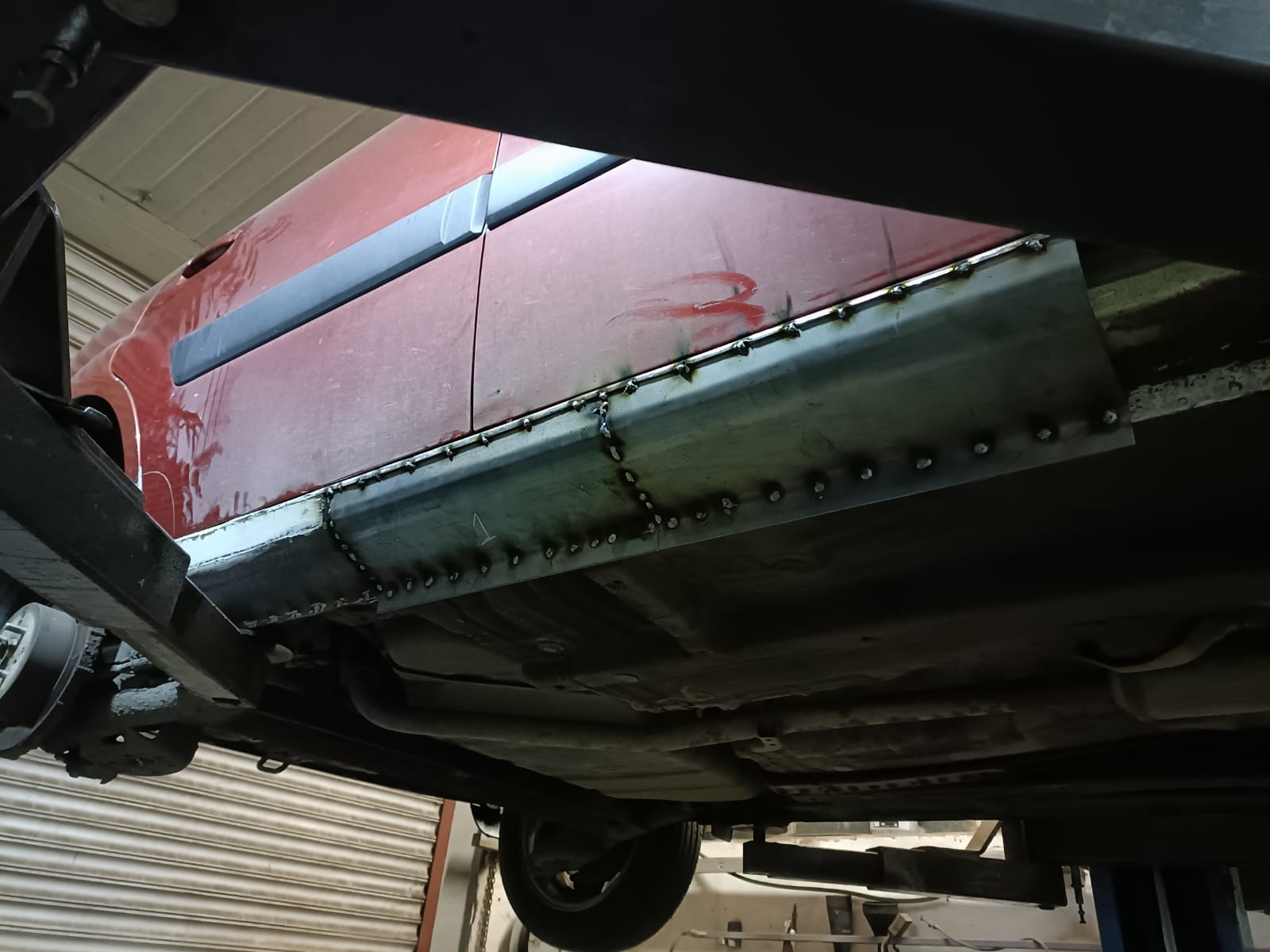
What Is the “Underbody”?
The underbody of a vehicle refers to all the structural and semi-structural metalwork on the underside of the car — everything visible when you look underneath from ground level.
The key components include:
Floor pan — the large sheet steel panel that forms the interior floor of the vehicle. Passengers sit above it; road and weather attack it from below. It’s structural, particularly around the central tunnel and at the sill junctions.
Sill box sections — the hollow steel channels running along each side of the vehicle, below the doors. These are primary structural members: the sill carries a significant part of the body’s rigidity. They’re particularly vulnerable to rot on Irish vehicles because they collect road salt spray and standing water internally when drain holes block.
Outriggers and cross members — the transverse structural members that connect the main longitudinal rails. Outriggers are the short sections that extend from the central structure to the sill. They’re common rot points and frequently failed at NCT.
Chassis rails — the main longitudinal structural members running fore-to-aft under the floor. On separate-chassis vehicles these are the primary structure; on monocoque cars they’re integrated box sections within the underbody.
Wheel arch inners — the metalwork inside the wheel arch. Road spray accumulates behind arch liners and corrodes these sections from the inside.
Boot floor — the floor of the boot, including the spare wheel well. A very common rot location on Irish vehicles because standing water in the spare wheel well goes unnoticed for years.
What Is Underbody Welding, Specifically?
Underbody welding refers to the structural repair of any of the sections above using metalwork: cutting out corroded or damaged sections and welding in new steel to restore structural integrity.
It is specifically not:
- Filling holes with filler or fibreglass
- Applying rust converter over perforation and painting over it
- Bonding new panels with adhesive over old rot
- Any repair that doesn’t involve genuine structural welding of new steel
These alternatives are cosmetic repairs. They may improve the appearance and they may temporarily pass a cursory look, but they don’t restore structural integrity and they won’t pass an NCT retest with a competent inspector. The tester physically prods structural sections — a non-weld patch often passes the visual check but fails the probe test.
Proper underbody welding means the rotten or damaged metal comes out entirely, new steel is formed to shape and size, and it’s seam welded into place with full penetration welds. The result is a section that is structurally equivalent to — or in some cases stronger than — the original.
Why Do Irish Vehicles Need Underbody Welding?
The short answer: Irish road and weather conditions are exceptionally hard on vehicle underside metalwork.
Road salt is applied to Irish roads during cold snaps. Salt solution sitting on steel massively accelerates corrosion compared to plain water. A vehicle used through an Irish winter accumulates salt in every underbody nook and recess.
Persistent damp means moisture doesn’t dry out between exposures. Box sections and joins stay wet for extended periods — accelerating internal corrosion in sections that are never directly visible.
Potholed roads on the A91, A1, and the network of rural roads through Co. Louth and south Armagh chip underseal and create water entry points. Once moisture gets beneath underseal, it spreads under the intact coating invisibly.
The result is that underbody structural rust is endemic on Irish vehicles over a certain age — more so than in almost any other comparable European climate. Most vehicles from 10 years old onward are worth an underbody inspection; many will show something that warrants attention.
What Does the Repair Process Look Like?
When you bring a vehicle to Quinn Engineering in Omeath for underbody welding:
-
We put it on the lift and inspect the full underside under proper lighting. The first look is always broader than just the single area on the NCT report — adjacent sections often need attention too.
-
We clean back the repair area to bare metal. Underseal, rust scale, and debris are removed. You cannot produce a sound weld in contaminated metal.
-
We cut out the rotten or damaged sections — back to sound metal, not just to the edge of the obvious damage.
-
We form and fit new steel — cut to shape, fitted to the geometry of the vehicle.
-
We seam weld — full seam welds, not spot welds where a seam is required. Welds are dressed back cleanly.
-
If a retest is pending, we leave the repair bare — no underseal over it — so the NCT inspector can verify the work directly.
We advise on protective coating after any retest requirement is complete.
Frequently Asked Questions
Q: Is underbody welding the same as chassis repair? A: They overlap significantly. Chassis repair is the broader term that includes underbody structural work. Underbody welding specifically refers to welded structural repair of the underside panels and sections — which is the most common type of chassis repair on Irish cars. See our chassis repair page for more.
Q: How long does underbody welding take? A: A single-section repair is typically a day’s work. Multiple sections can take two to three days. We give you a timeline when we assess the vehicle.
Q: Will underbody welding affect how my car drives? A: Not negatively. Restoring structural integrity to corroded sections can actually improve body rigidity — reducing flex and noise on rough surfaces. It won’t change handling geometry unless the repair also corrects distortion.
Q: Can any garage do underbody welding? A: Not well. Structural underbody welding is specialist metalwork — different from general panel beating or exhaust welding. It requires proper MIG or MIG/MAG welding equipment, experience with structural sections, and an understanding of what constitutes a sound structural repair vs. a cosmetic patch. At Quinn Engineering, structural metalwork is our core trade.
If you’re in Dundalk or Co. Louth and want to understand what’s underneath your vehicle, or you need underbody welding for an NCT fail, contact Quinn Engineering in Omeath. We’ll give you an honest assessment and a straight explanation of what’s involved. See our underbody welding service here.